Introduction to the Taurus molecular cloud
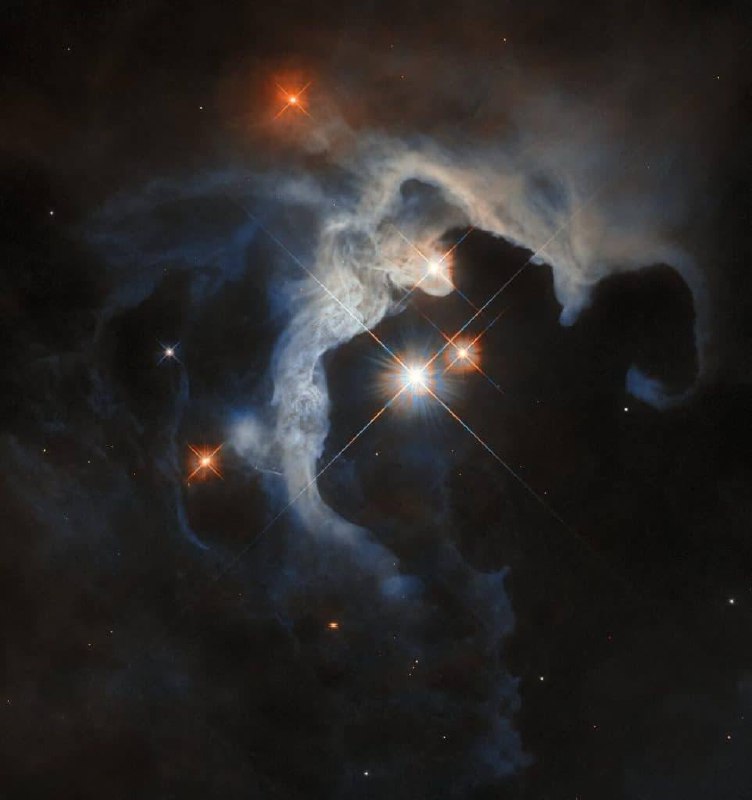
The Hubble Space Telescope continues to expand our understanding of the universe with its latest capture of a stunning reflection nebula, known as GN 04.32.8, located in the Taurus molecular cloud. Situated 480 light-years away from Earth, this celestial phenomenon provides a remarkable window into the process of star and planet formation.
The role of reflection nebulae in star formation
Reflection nebulae are clouds of gas and dust that reflect the light of nearby stars. In the case of GN 04.32.8, the nebula is illuminated by the glow of three young stars. These stars are still in the early stages of their life cycle, with one of them notably encircled by a protoplanetary disk that can be seen edge-on. This positioning allows astronomers to study the disk’s structure and composition, offering clues to the early stages of planet formation.
Insights from the Hubble Space Telescope
The images captured by Hubble provide valuable insights into the complex processes that lead to the birth of stars and planets. The vibrant interplay of glowing gas and dust reveals the dynamic environment within which these celestial bodies take shape. Such observations are crucial for understanding the initial conditions that influence the development of planetary systems.
The significance of studying star birth regions
Regions like the Taurus molecular cloud are of great interest to astronomers because they allow the study of star formation in various stages. Observing these regions helps scientists piece together the lifecycle of stars, from their formation in dense clouds of gas and dust to their eventual evolution into mature stars with planetary systems. This knowledge is essential for comprehending the broader cosmic context of our own solar system’s formation.
Conclusion
The Hubble Space Telescope’s ability to capture detailed images of star-forming regions like the Taurus molecular cloud highlights the importance of continued exploration and observation. These celestial snapshots not only enhance our understanding of the universe but also inspire a sense of wonder about the origins of stars and planets. As technology advances, future missions will undoubtedly build upon Hubble’s legacy, offering even deeper insights into the mysteries of the cosmos.